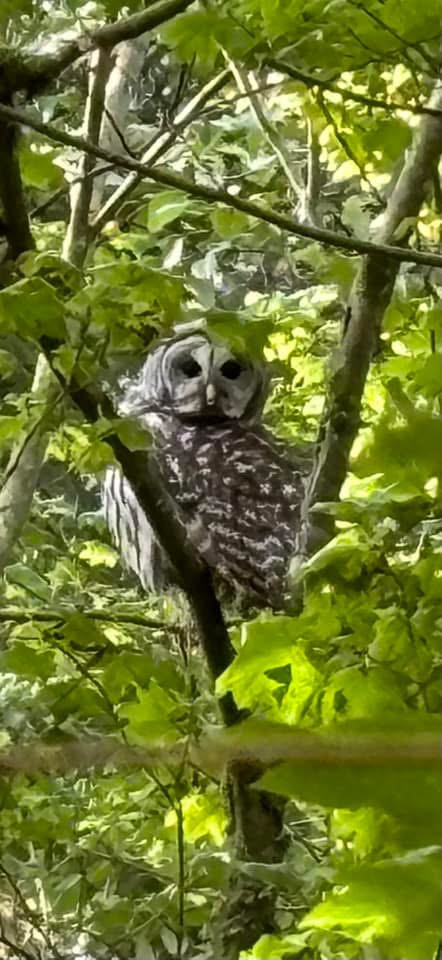
Our featured creature for the month of March is the BARRED OWL.
The Barred Owl is a medium-to-large owl native to North America. It is named for the horizontal “barred” pattern on its chest and vertical streaks on its belly. This owl has a rounded head, dark brown eyes (unlike many other owls that have yellow eyes), and no ear tufts. Its plumage is a mix of brown, white and grey, providing excellent camouflage in forested environments.
They inhabit mature, mixed forests with plenty of cover, particularly those near water sources like swamps, marshes, rivers and lakes, and are commonly found in the eastern United States, parts of Canada, and the Pacific Northwest.
The Barred Owl’s hooting call, “Who cooks for you? Who cooks for you-all?” is a classic sound of old forests and treed swamps. They are a lot easier to hear than to see.
Unlike some owls that are strictly nocturnal, Barred Owls can be active during the day, though they are most vocal and active at dawn and dusk. They are generally solitary outside of the breeding season but form strong pair bonds. They are territorial and will defend their nesting areas from other owls or predators. They are sit-and-wait predators, meaning they perch silently and scan for movement before swooping down to capture prey. Their diet is highly varied, including small mammals (mice, voles, rabbits), birds, amphibians, reptiles, insects and even fish. They are strong fliers but generally prefer short bursts of flight through dense forest rather than long-distance soaring.
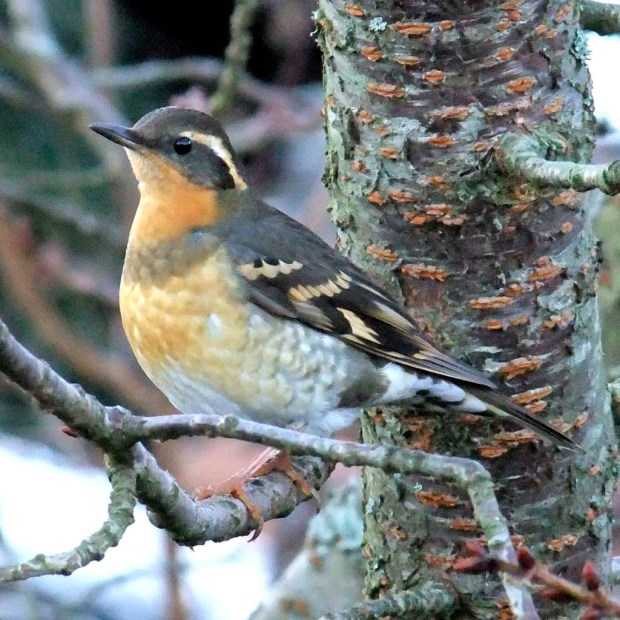
Our featured creature for the month of January is the beautiful VARIED THRUSH.
The Varied Thrush is a medium-sized bird native to the forests of the Pacific Northwest, known for its striking plumage, which features a combination of slate-blue, orange, and black colors that create a visually stunning appearance. Male Varied Thrushes are dark blue-gray on the back, rich burnt-orange below with a sooty-black breastband and orange line over the eye. The wings are blackish with two orange bars and orange edging to the flight feathers. Females have the same patterns, but are paler gray-brown than males. Typically found in coniferous and mixed forests, the Varied Thrush prefers dense underbrush where it can forage for insects, fruits, and seeds. It is also known for its melodious song, which can often be heard during the breeding season, adding to its allure as one of North America’s more enchanting bird species.
 WILDSCAPING OUR NEIGHBOURHOOD SOCIETY